Friday, 14 November 2014

A look at the Shenyang J-31


China has unveiled a sophisticated new stealth fighter jet at an air show, in a show of muscle during a visit by US president Barack Obama for an Asia-Pacific summit.
Full article

It must be able to carry out multiple types of mission including close air support, air interdiction, aerial bombardment and suppression of enemy air defenses. For this reason, the article stated, the heavier J-20 is designed to engage enemy fighters at high altitude while the J-31 is more likely to be used in operations against ground targets at medium or low altitude.
Full article 

Article that mentions J-31 engines


Opinion Piece by Luke Herbert

The unveiling of the Shenyang J-31 multi role Stealth combat aircraft by the People's Liberation Army Air Force coincided with the 2014 Asia-Pacific Economic Cooperation(APEC) summit held in Beijing.


I have chosen to leave the topic of how the J-31 is powered by Russian designed jet engines for a separate blog entry that will look at Chinese aviation industry's efforts in the field of jet engine development in depth.

What is overlooked by the main stream media reports of the formal unveiling of the J-31 is that while the aircraft was was being developed simultaneously the Chinese will have either constructing new factories and or retooling existing ones to mass produce the design for export purposes and service in the People's Liberation Air Force.


The J-31 reflects the Chinese and Russian design philosophy of being comparable to existing more technology advanced designs while being less cutting edge. By its less advanced nature the J-31 will be inexpensive and easy to mass produce when the aircraft is ready to enter front line service. This approach allows the People's Liberation Air Force to field the J-31 as an aircraft that will be just good enough to get the job or roles assigned to it done so to speak and is comparable to the Lockheed Martin F-35 Lightning II.


Much of the commentary in the main stream media and the blogosphere has and will focus on how the J-31 matches up to the F-35 which is considered to be a direct equivalent in the design stakes. In contrast the trade off for the F35 being on the cutting edge of aviation technology is reflected in the aircraft's extremely expensive per unit costs and slow production times on the factory floor. The F-35 is in service with the United States Air Force and will enter service with the Royal Air Force ,Royal Australian Air Force,Royal Canadian Air Force,The Italian Air Force,Royal Netherlands Air Force,Royal Norwegian Air Force and The Turkish Air Force.


I believe that a useful historical parallel for the reader is how the Luftwaffe squadrons equipped with the ME 262 the world's first operational jet fighter were unable to overcome the allies ten to one superiority in number of aircraft despite all the technology and aerial performance advantages the Me-262 enjoyed in the air. Like wise in a future war the F-35 and F-22 squadrons of the future will be flown into the meat grinder of attrition by six to one advantage the enemy will enjoy in numbers of combat aircraft.

In summary I believe that the J-31 will successfully fill the role of a multi role combat aircraft in the People's Liberation Air Force. The notion that the J-31 only has to be “just good enough” is at the heart of Chinese and Russian philosophies towards the design of aircraft and other war material.

Lastly lets compare how the J-31 and the F-35 design philosophies will materialise in a future war. The nature of the J-31 mass production friendly design will allow the People's Liberation Air Force to replace losses from combat and accidents in a straight forward manner. The United States Air Force and its counterparts where the F-35 is in front line service will face a short fall of aircraft due production rates not keeping up with losses.



Tuesday, 11 November 2014

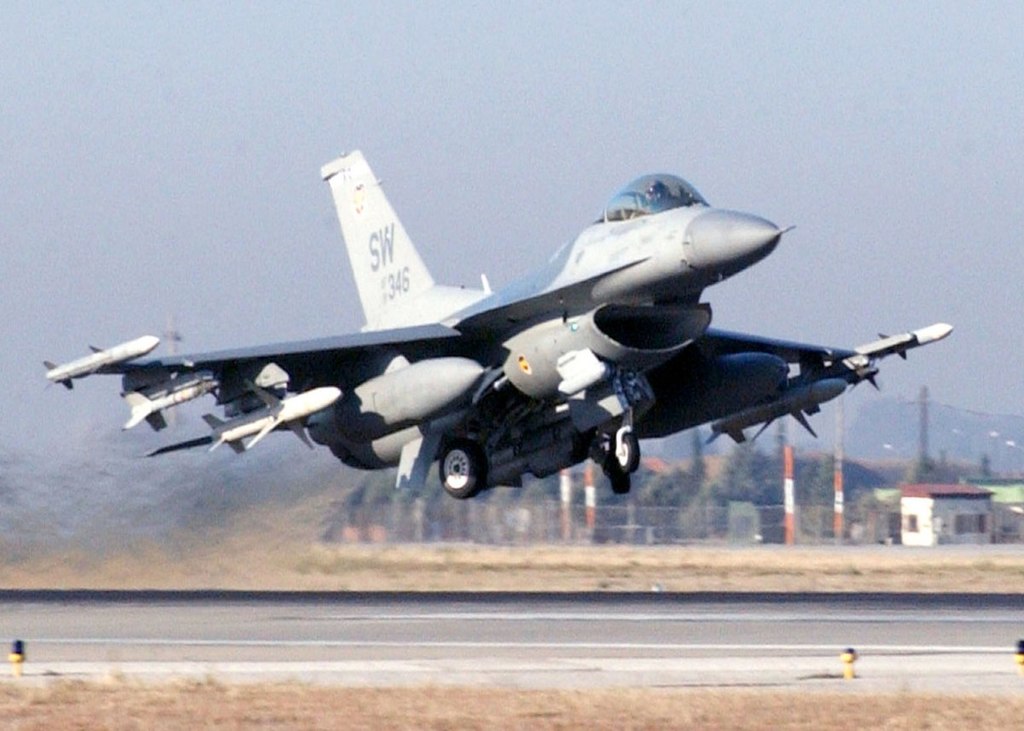
Iraqi F-16s to remain in the USA pending the military situation

The initial batch of Lockheed Martin F-16 Fighting Falcon combat aircraft for the Iraqi Air Force (IqAF) will remain in the United States until the security situation in Iraq improves, the US Department of Defense (DoD) disclosed on 10 November. Iraq has ordered 36 F-16C/D Block 52 aircraft in all, the first of which were due to be delivered to Balad Airbase earlier this year. However, the deteriorating security situation on the ground meant that the DoD had to evacuate its contractors at the base, and postpone handing over the jets.
Full article


Right a United States Air Force F-16.
Public Domain image.


Looking at the situation in Iraq the defenders are holding out while Isis resupplies and regroups. Once Isis resumes its offensive they will gain control of the remaining areas under Iraqi government control chiefly Baghdad.

 The Department of Defense decision was dictated by the circumstances that have unfolded that is the rise of Isis in Iraq. Also worth noting is how Isis has already captured a variety of US manufactured equipment in Iraq adding F-16s to the mix would have only given Isis and other countries like Russia and China a chance to go over the aircraft tooth and comb an intel gathering bonanza.

 I believe that the fact no indicators exist that the Iraqi F-16's will in the future be deployed alongside other coalition air forces like the RAAF who are conducting air strikes against Isis is a sign that US military and political leaders have written off Iraq behind closed doors. If Iraq hasn't already been written off than why isn't gradually increasing the Iraqi air force roles in combat Isis even if it is from a neighboring country being made a priority?

 Events in Iraq will take time to play out so the aircraft may gather dust so to speak while they remain in the USA. After Isis completes its take over of Iraq a new buyer will have to be found for the F-16s. This raises the most interesting question concerning who will the eventual buyer of the F-16s will be?

Saturday, 8 November 2014

The Lens of History: Episode Five Dave Steward of the FW de Klerk Founda...


Dave Steward of the FW de Klerk Foundation joins Luke Herbert for a chat about the Foundation role in promoting and preserving South Africa's post Apartheid Constitution.

Just how South Africa's Constitution compares to those of the United States of America and the United Kingdom are discussed around the Coffee table. The challenges that South Africa faces in tackling poverty and improving education are also discussed.

The Lens of History: Episode Four Author Jack Hurst


Author Jack Hurst joins Luke Herbert for a chat about his book Born to Battle Grant and Forrest Shiloh, Vicksburg, and Chattanooga. Find out what Ulysses S.Grant and Nathan Bedford Forrest two seemingly very different historical figures backgrounds shared in common shaped the actions they undertook during the battles they unknowingly opposed each as commanders on the battlefield.

 Tune in to hear a unique non American perceptive on Ulysses S.Grant and Nathan Bedford Forrest respective experiences and how they related to the later military history of two world wars.

Friday, 7 November 2014

The Lens of History: Episode Three interview Author Keith Nell


 Luke Herbert chats with author Keith Nell about his book Viscount Down The complete story of the Rhodesian Viscount disasters as told by a SAS operator. Keith Nell sheds light on little known gripping and horrific events .

 Keith Nell's account offers a fascinating insight into events that took place during the Rhodesian Bush War. The listener will no doubt find that many lessons can be learned from the shoot down of the Viscount airliners and the hunt for the terrorists responsible.

The Lens of History: Episode Two Russian Military Modernisation


 Justin Oldham joins Luke Herbert for a chat about the implications of the modernisation of the Russian Armed Forces. NATO countries reduce defence spending and reduce the size of there armed forces Russia is modernising Cold War era platforms. Tune in to find out how the part of the world you are living in could be affected.

 While the fresh paint dries in the studio, Luke Herbert and Justin Oldham also cover how the Russian Armed Forces weathered and are recovering from the collapse of the Soviet Union.

Thursday, 6 November 2014

The Lens of History: Episode One the Ukraine the ghost of Munich 1938?


 In this inaugural edition of The Lens of History program Luke Herbert is joined on the couch by author Justin Oldham and political commentator Martin Bain for a discussion about events in the Ukraine.

 As Vladimir Putin leads a resurgent Russia in an expansionist mode is he just defining the Russian sphere of interest or is the 1930's being replayed and another European War set to occur?